Most "grow fast" advice fails because it treats YouTube like a trick system. A creator is told to post daily, copy trending titles, or optimize tags, but the channel still stalls because the core viewer promise is unclear. Sustainable growth comes from three compounding loops: better topics, better packaging, and better viewer satisfaction.
This guide uses public signals that any creator can inspect: upload frequency, recent median views, title patterns, thumbnail promises, comments, topic clusters, and whether new videos outperform the channel baseline. Private YouTube Studio metrics are better when you own the channel, but public data is still enough to make smarter decisions.
Start With Baseline, Not Subscriber Count
Subscriber count is a lagging indicator. A channel with 200,000 subscribers can have weak recent demand, while a channel with 12,000 subscribers can be growing quickly. Use the last 10 to 20 long-form uploads and calculate the median view count after excluding obvious outliers.
Baseline example
If a channel's recent median is 8,000 views and three videos in a new topic cluster reach 18,000, 24,000, and 21,000 views, that is a stronger signal than a single viral spike. If the next five videos fall back to 5,000, the format may not be repeatable.
Improve Topic Selection
A good topic combines demand, specificity, and creator fit. "Productivity tips" is too broad. "How I plan a week as a medical student" has a clearer audience and a stronger proof requirement. Channels like Ali Abdaal grew because the topics connected personal systems with repeatable viewer problems, not because every upload chased a random trend.
Use Niche Insights to compare recent videos around a topic. Look for videos from smaller channels that outperform their normal baseline. That suggests the topic has accessible demand instead of only rewarding entrenched authorities.
Packaging: Titles and Thumbnails
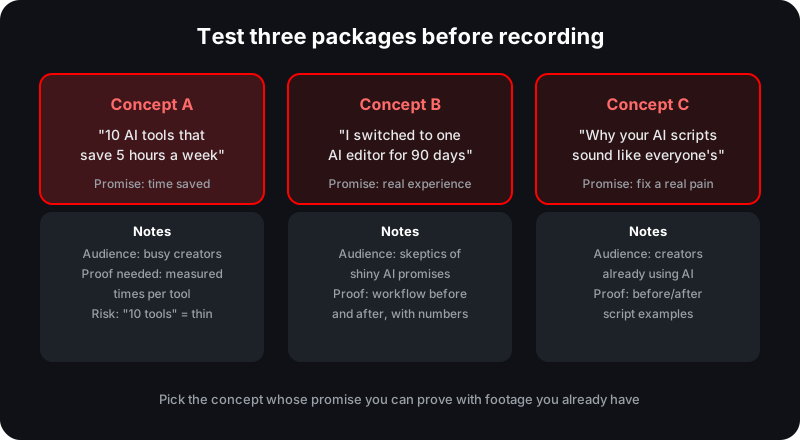
Packaging is the bridge between the topic and the click. A good title tells the viewer what problem will be solved and why this version is worth their time. A good thumbnail makes the contrast visible. Study public examples from channels such as Veritasium, Mark Rober, and Think Media: the title and thumbnail usually create one clear curiosity gap, not five competing ideas.
Retention Starts Before the Video
Retention is not only editing speed. Viewers stay when the opening confirms that the promised video is the one they clicked. The first 30 seconds should identify the viewer problem, explain the payoff, and remove uncertainty. Avoid long brand intros unless the audience already expects them.
| Growth lever | Weak version | Stronger version |
|---|
| Topic | Broad category | Specific viewer problem |
| Title | Keyword list | Clear promise or tension |
| Opening | Channel intro | Immediate proof of relevance |
| Series | Random uploads | Repeatable topic cluster |
| Analysis | Views only | Median views, outliers, comments, format fit |
Create Topic Clusters
Google Search and YouTube both reward clarity. A channel with a recognizable cluster becomes easier for viewers to understand and easier for algorithms to test. Build clusters around problems: beginner setup, mistakes, comparisons, templates, case studies, and advanced follow-ups. On Norlytics, the same cluster approach connects the Creator Dashboard, channel audit checklist, and channel comparison guide.
Publishing Rhythm
Consistency matters because it creates more learning cycles. It does not mean every creator should publish daily. A finance explainer with research and charts may need one strong video per week. A commentary channel may test faster. Pick a rhythm that lets you maintain quality, then review performance every four to six uploads.
Common Mistakes
- Copying a viral format without understanding why it worked.
- Judging a new direction from one upload instead of a small test set.
- Optimizing tags while the topic and opening are weak.
- Ignoring comments that reveal confusion, objections, or follow-up demand.
- Changing everything at once so you cannot learn what helped.
A Four-Week Growth Test Plan
Week one should be research and packaging. Pick one audience problem, collect 20 public examples, and write three title/thumbnail directions before recording. Week two should publish the first test video and document the exact hypothesis: topic, promise, format, and expected viewer. Week three should publish a related follow-up that changes only one major variable, such as title angle or video structure. Week four should review median views, comments, and repeat questions, then decide whether to expand the cluster or retire it.
This slower method is still faster than random uploading because every video teaches something. The goal is not to force a viral result. The goal is to build a channel memory: what this audience clicks, where they drop, what they ask next, and which ideas are worth turning into a repeatable series.
Measure public growth signals
Use Creator Dashboard to compare recent median views, upload rhythm, top videos, and repeatable formats before planning your next content test.
Analyze a ChannelFrequently Asked Questions
How many videos should I publish before judging a growth experiment?
Use at least three to five related uploads when possible. One video can be distorted by timing, packaging, or a random recommendation test.
Is posting daily the fastest way to grow?
Only if quality remains high and the format supports fast publishing. Many channels grow faster with fewer, stronger videos.
What public metric matters most?
Recent median views relative to channel size is more useful than subscriber count alone.
Sources and Methodology
This guide combines public YouTube Data API signals, Norlytics tool methodology, manual review patterns used by creators and sponsors, and official YouTube or Google policy documentation where rules are involved.
Related Norlytics resources
 Norlytics