Few factors split creator earnings as sharply as geography. Two channels pulling identical view counts can still land in very different revenue bands, because advertisers bid more where customer value, competition, and purchasing power are higher — and those bids cascade through CPM, playback-based CPM, and finally the creator's RPM.
Public tools cannot know a channel's private audience geography with certainty. YouTube Studio shows creators their real country breakdown. Norlytics uses public signals to estimate likely geography and always treats the result as an assumption, not a private analytic.
CPM vs RPM by Country
CPM describes what advertisers pay for ad impressions. RPM describes the creator's revenue per 1,000 total views after YouTube's revenue share, unmonetized views, country mix, format mix, and other factors. A high-CPM country can still produce modest RPM if many views are not monetized or if the format is Shorts-heavy.
| Country signal | Why it matters | Creator interpretation |
|---|
| United States, Canada, UK, Australia | Generally strong advertiser competition | Often higher RPM potential, especially in finance, business, software, and education |
| Western Europe | Strong but varied by language and niche | Good sponsorship fit may matter as much as ads |
| Large emerging markets | Huge audience scale, lower average ad rates | Volume, products, local sponsors, and community can offset lower RPM |
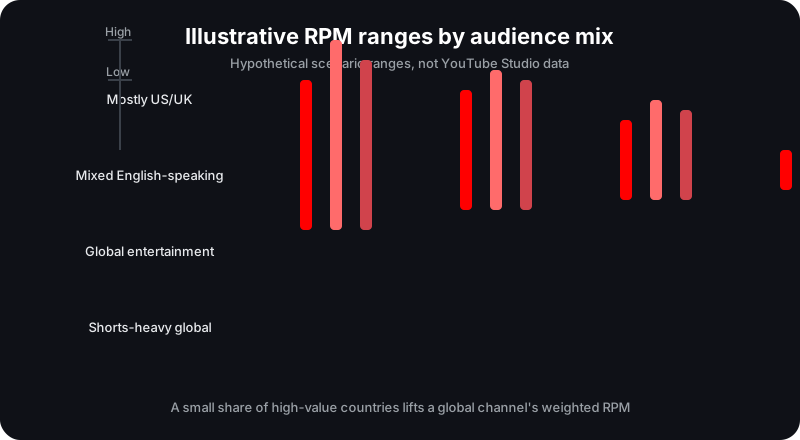
| Mixed global audience | Revenue depends on weighted average | A small share of high-value countries can lift overall RPM |
How to Estimate Audience Country Publicly
Use language, upload time, references, comments, currency, sponsor geography, and search intent. A channel using US tax examples, posting for North American evenings, and receiving comments from US viewers likely has a different country mix from a channel using Hindi titles and India-specific examples.
The channel country analyzer guide explains the limitation in more depth. The key rule is to avoid pretending public signals equal YouTube Studio data.
Real Example Patterns
A personal finance channel that explains US retirement accounts is likely more valuable to US advertisers than a general entertainment channel with the same views. A software tutorial channel teaching Notion, Excel, or AI tools to English-speaking professionals may attract global viewers but still monetize strongly because the viewer intent is commercial. A music or meme channel may generate huge view volume while earning lower ad revenue per view.
How Creators Should Use Country Data
Do not chase a country by faking identity or forcing unnatural language choices. Instead, clarify who the video is for. If you want a US audience, use examples, units, prices, and problems that match that viewer. If your strongest audience is local, build products, sponsors, and community offers that fit that market.
Common Mistakes
- Assuming CPM equals creator earnings.
- Applying one country's RPM to a global channel.
- Ignoring Shorts and unmonetized views.
- Using country estimates as if they were private YouTube Studio analytics.
- Choosing a niche only because a country pays more.
Revenue Estimate Method
Norlytics estimates revenue by combining niche assumptions, likely geography, content format, channel scale, and view patterns. The output is a range because actual monetized views, ad fill, seasonality, and viewer demographics are private. For serious planning, use the range as a scenario model, not a promise.
How Country Mix Changes the Same View Count
Imagine two channels both receive 500,000 monthly views. Channel A teaches US small-business taxes to viewers mostly in the United States. Channel B publishes general entertainment clips to a broad global audience. Channel A may have fewer casual viewers but stronger advertiser intent. Channel B may have more scale and cultural reach but a lower ad value per view. Neither channel is automatically better; they simply need different monetization plans.
For Channel A, better strategy might include long-form search videos, downloadable templates, sponsor integrations, and careful accuracy review. For Channel B, better strategy might include Shorts reach, brand-safe recurring formats, merch, live community, and regional sponsorships. A country estimate only becomes useful when it changes a decision.
When Country Targeting Hurts Quality
Creators sometimes try to force a high-CPM country by switching language, examples, or upload times without understanding that audience. This can weaken trust. A better approach is to serve a clear viewer completely. If the viewer is in Germany, Brazil, India, France, or the United States, the examples should match their context. Relevance beats artificial targeting.
Estimate revenue with visible assumptions
Use Norlytics to review public channel signals, estimated geography, and revenue ranges with methodology notes.
Use Channel AnalyzerWhy Country CPM Differences Exist
Country gaps track advertiser demand, not just audience size. In high-income markets advertisers bid more aggressively because each customer's lifetime value is higher — a finance or business-software campaign in the United States or United Kingdom competes for viewers with strong purchase power and commercial intent. The same niche in a lower-income market draws far less competition per impression even when audience size is similar.
Regulation shapes the gap too. Markets with stricter rules around age-restricted content, financial products, gambling, or health claims can limit which advertisers may appear at all, which lowers ad fill and softens rates. That is why the same format can monetize differently in two markets that look alike on paper.
Language adds another layer to effective CPM. A channel serving Spanish-speaking viewers in the United States, or English-language content watched mostly in India, will not command the same rate as a channel matched to the local high-value ad market, because language controls which campaigns can bid on that audience and how much they are willing to pay.
How to Read a CPM Table Correctly
Start by separating impressions from playbacks. CPM is what advertisers pay per 1,000 ad impressions, and an impression only registers when an ad is actually served — it is not the same thing as a video view. Long-form videos with ads, Shorts without them, and videos with low ad fill can post similar view counts yet carry very different CPMs, so a table quoting "$8 CPM" assumes a format and fill mix your channel may not match.
Published country tables are ranges, not rates. Numbers move with the month — Q4 budgets push rates up while early-year spend dips — and with the data source, the niche, and the snapshot date. Use a table to build scenario ranges for planning, then compare against your own YouTube Studio numbers once you have them. A table is a starting hypothesis, never a payout promise.
Caution: third-party CPM lists are estimates compiled from surveys and sampled data. They can be months old and weighted toward particular niches, so treat every published figure as a range with a wide margin and sanity-check it against your own monetized playback and RPM data when you can.
Example: two audiences, one table
Suppose a published table lists $9 CPM for the United States and $1.20 for a large emerging market. A channel with 100,000 monthly long-form views, 70% from the US and 30% from the emerging market, should not be modeled at either number alone. A weighted mix of 70% of $9 plus 30% of $1.20 lands near $6.66 per 1,000 monetized impressions — before fill, format, and niche factors are applied.
Frequently Asked Questions
Which country has the highest YouTube CPM?
There is no single permanent leader. High advertiser markets such as the United States, Canada, the UK, and Australia often perform strongly, but niche and audience intent matter.
Can I see another channel's real country breakdown?
No. A channel's real audience geography is private YouTube Studio data. Public tools can only estimate from external signals.
Should I target only high-CPM countries?
Only if you can serve those viewers authentically. Audience fit and trust matter more than forcing a high-CPM geography.
Sources and Methodology
The analysis here draws on public YouTube Data API signals, the methodology behind Norlytics tools, manual review habits that creators and sponsors use in practice, and official YouTube or Google policy documentation wherever actual rules are at stake. None of it replaces a channel's own private YouTube Studio numbers.
Related Norlytics resources
 Norlytics