YouTube RevenueLast updated August 5, 2026 · 7 min read
YouTube Ad Formats Explained: What Each Format Pays and How to Plan Around It in 2026
There are six main YouTube ad formats, and each one pays differently. Here is what each format is, how the 55 percent creator split works, and how to plan your videos around the formats that actually generate revenue in 2026.
Every ad on YouTube belongs to one of a handful of formats, and the format that plays determines more about your revenue than almost anything you control in the upload flow. The length of your video decides whether mid-rolls are possible. The type of ad an advertiser bought decides what the viewer sees and how the auction prices it. This guide walks through the six main formats, what each one pays in practice, and how to plan a video strategy around them in 2026.
The Six Ad Formats That Generate Your Revenue
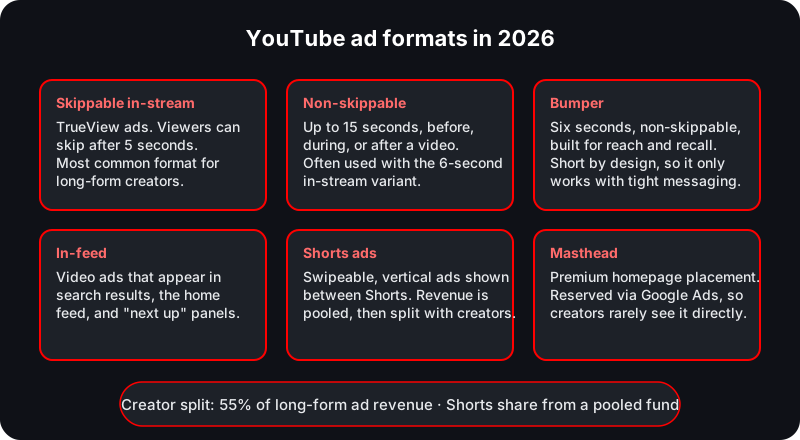
Skippable in-stream ads, historically called TrueView, are the default for most long-form monetized videos. The viewer sees the ad before, during, or after a video and can skip after five seconds. Advertisers only pay when a viewer watches a meaningful portion of the ad, or through a completion, so these ads reward advertising that people actually tolerate. This is the format most creators see show up on their own long-form content.
Non-skippable in-stream ads are the direct opposite: up to 15 seconds long, they play before, during, or after a video and cannot be skipped. There is also a shorter six-second in-stream variant that behaves like an unskippable teaser. Advertisers buy these when they want the full message guaranteed to be seen, and because they interrupt more, they are usually priced at a premium per impression.
Bumper ads are six seconds long and non-skippable. They are built for reach and brand recall rather than storytelling, so they are short by design. Bumpers appear less frequently on individual videos than the in-stream formats, but they are a consistent part of the ad mix.
In-feed ads are the thumbnail-and-text ads that appear in search results, on the home feed, and in the "next up" and related-video panels. They behave like promoted videos rather than interruptions, and a viewer has to choose to tap into them. In-feed ads are less visible to a creator's audience because they often sit beside or below the video player.
Shorts ads are swipeable vertical ads that appear between Shorts in the Shorts feed. Revenue from the Shorts feed is pooled across creators and shared through a separate arrangement rather than the standard watch-page split, which is why Shorts RPM behaves differently from long-form RPM.
Finally, the Masthead is a reserved homepage placement bought through Google Ads that most creators never see directly. It sits at the top of the YouTube homepage and sells at a premium, but it does not play a meaningful role in a typical channel's day-to-day revenue.
The six formats that make up YouTube's ad business, and where each one actually appears.
Format
Where it appears
What creators should know
Skippable in-stream
Before, during, after long-form
Pay on view or completion; the most common watch-page format
Non-skippable in-stream
Before, during, after long-form
Up to 15 seconds, plus a 6-second variant; cannot be skipped
Bumper
Before, during, after long-form
Six seconds, non-skippable, built for reach and recall
In-feed
Search, home feed, related panels
Promoted thumbnails; the viewer must choose to click
Shorts ads
Between Shorts in the feed
Pooled revenue model, separate from watch-page ads
Masthead
YouTube homepage
Reserved placement; rarely relevant to a typical channel
What Each Format Actually Pays
The headline number to remember for long-form watch-page ads is the 55/45 split. Creators earn 55 percent of net ad revenue from ads displayed on their videos, and YouTube keeps the other 45 percent to run the platform. That split applies to the formats that run inside the video player, from skippable in-stream to bumper ads.
Shorts are a different machine. Revenue from the Shorts feed is pooled, then distributed to creators based on their share of the views in the pool, so the per-format logic of watch-page ads does not apply. A channel's Shorts earnings depend less on which ad plays and more on how its total Shorts view share compares to everyone else in the pool.
CPM is the price advertisers pay per thousand impressions; RPM is what actually lands in your pocket per thousand views after the 45 percent cut and any deductions. A higher CPM does not mean higher take-home pay. Plan around RPM, and read our full breakdown of RPM versus CPM before you set expectations.
Why Videos Over Eight Minutes Can Earn More
Videos longer than eight minutes can place mid-roll ad breaks, which is one reason longer content often carries higher RPM potential. A two-minute video can only support a pre-roll or post-roll; an eleven-minute video can hold an extra break in the middle where viewers are still engaged. More breaks mean more ad impressions per view, and more impressions multiply into higher RPM.
That does not mean padding a video to cross eight minutes. Mid-rolls only earn when viewers are actually watching, and a dull middle destroys retention, which suppresses the ad impressions that follow. The efficient move is to design genuinely longer videos when the topic supports it, with structure that keeps average view duration high.
One long video vs two short parts
A 10-minute tutorial can hold a mid-roll break while two 5-minute parts only support pre-rolls and post-rolls. If viewers watch both parts, the pair earns more total impressions; if they abandon part two, the single 10-minute video wins on both RPM and watch time.
Where Premium Fits Into Your Revenue Mix
Premium subscribers see no ads at all, yet their viewing still pays creators through a separate pool: the Premium watch-time pool, which is distributed by watch-time share rather than by impressions. Premium revenue appears alongside ad revenue in your analytics, and for many niches it is a meaningful share of the total. We cover the mechanics in our guide to YouTube Premium revenue.
Both streams matter when you compare channels. A channel whose audience skews toward premium members can earn a materially different mix than one that relies on advertiser demand alone, even at the same view count. The cleanest way to reason about the two together is revenue per thousand views, and our revenue guide shows how that number varies across niches and strategies.
How to Plan Your Video Strategy Around the Formats
None of this guarantees a payout. Ad formats, auction prices, and viewer geography all move the number, which is why a per-thousand-view estimate is the only honest way to compare your revenue potential across strategies. These five habits keep the formats working for you instead of against you:
Choose video length by how many ad breaks the content can honestly support.
Keep average view duration high; retention is what turns breaks into impressions.
Expect skippable in-stream to be the majority of the watch-page ads you see.
Treat Shorts as a separate revenue line with its own pooled economics.
Track RPM per thousand views instead of chasing headline CPM numbers.
Remember that Premium members add revenue without ever seeing an ad.
Estimate the formats behind your revenue
Run any channel through the Channel Analyzer to see engagement, view patterns, and niche context that shape what ads can earn.
Skippable in-stream, non-skippable in-stream, Bumper, In-feed, Shorts ads, and the Masthead. The first three run inside long-form videos, In-feed shows in search and the home feed, Shorts ads run in the Shorts feed, and the Masthead is a reserved homepage placement.
What share of ad revenue do creators earn on long-form videos?
On watch-page ads, creators earn 55% of net ad revenue and YouTube keeps 45%. Shorts use a separate pooled model, so the 55% split applies to long-form watch-page ads only.
Do longer videos really earn more?
Videos longer than 8 minutes can place mid-roll ad breaks, which adds ad impressions per view and often raises RPM. Length only helps if viewers keep watching through the break.
Why doesn't a high CPM mean high take-home pay?
CPM is the price advertisers pay per thousand impressions. What creators earn per thousand views is RPM, which is calculated after YouTube's 45% share and other deductions, so planning should center on RPM.
Sources and Methodology
This guide synthesizes YouTube's official documentation for ad formats, revenue sharing, and partner earnings. Format behavior and revenue splits change, so verify current terms in YouTube Help before relying on specific figures.
This guide synthesizes YouTube's official documentation and public reporting. Figures that vary by audience, region, or advertiser demand are estimates, not guarantees.
 Norlytics