YouTube RevenueLast updated August 5, 2026 · 8 min read
YouTube Premium Revenue: How Premium Watch Time Pays Creators in 2026
Ad revenue gets the attention, but YouTube Premium is a quieter second stream that pays by watch time instead of impressions. Here is how the pool works, what the 55 percent split really means, and why binge-able content wins.
Ad revenue gets most of the attention, but for a growing number of channels YouTube Premium is a quiet second stream that behaves completely differently. Premium members pay a monthly fee and see no ads, and their watch time is pooled and redistributed to creators. Understanding how that pool works changes how you think about length, format, and audience. Here is how Premium revenue actually pays creators in 2026, and what you can do to capture more of it.
What YouTube Premium Actually Is
YouTube Premium is a subscription that lets members watch without ads, play videos in the background, and download content for offline viewing. The monthly fee replaces the advertising the member would otherwise generate. For creators, that means a premium member's viewing produces subscription revenue instead of ad impressions, and that revenue flows through a pool rather than a per-video auction.
Because Premium is a paid product, its subscribers tend to be heavier, more intentional viewers than the average ad-supported audience. That is not a detail; it shapes which channels benefit most. A channel that earns long, repeated sessions from a small group of loyal fans can build meaningful Premium revenue even before its ad revenue looks impressive. The two streams respond to different kinds of audience health.
The Pooled Payout Model
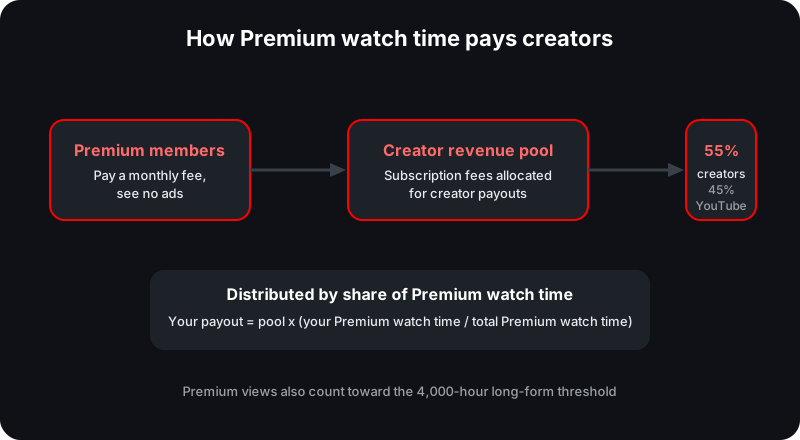
When a Premium subscriber watches your video, that watch time is added to a global pool of Premium watch time. Each month, YouTube takes the subscription revenue allocated to partners and splits it based on how much of that pool each channel earned. Creators receive 55 percent of the allocated subscription revenue and YouTube keeps the other 45 percent. YouTube states that the majority of subscription revenue goes to partners, so the pool is designed to be creator-heavy rather than platform-heavy.
Subscription fees enter one pool, and each channel's share is decided by its fraction of total Premium watch time.
The key difference from advertising is the basis of the payment. Ad revenue is priced by impressions in an auction, so it moves with advertiser demand. Premium revenue is priced by watch time, so it moves with your audience's behavior. The same video that earns a small ad payout because advertisers in your niche pay little can still earn a healthy Premium share if members watch it often and for long.
Aspect
Ad-supported views
Premium views
What generates revenue
Ad impressions sold in an auction
Share of the subscription pool
Basis of payout
Impressions and ad price (CPM)
Share of total Premium watch time
Your cut
55% of net ad revenue
55% of the allocated pool
Where it appears
Watch Page Ads line
Premium line in the Revenue tab
Length bias
Longer sessions mean more breaks
Binge-friendly, long-form wins
How Your Share of Watch Time Is Calculated
The practical formula is straightforward: your Premium revenue equals the creator pool multiplied by your Premium watch time divided by the total Premium watch time across all partners. Because the divisor is the entire platform's Premium watch time, your share is what matters, not how much you watched in absolute terms. A small channel with loyal Premium viewers can out-earn a larger channel whose audience is almost entirely ad-supported.
That formula also explains why per-view Premium figures are unreliable. Every Premium view does not carry a fixed price; it carries a share of whatever the pool happens to be that month. A channel's Premium RPM depends on the size of the pool, the plan mix of subscribers, and how much Premium watch time everyone else earned, all of which move constantly.
Premium payouts are distributed based on watch time, not ad impressions. A video watched for ten minutes by a premium member contributes more to your share than a five-second view, regardless of how many ads that video could have carried.
Why Long-Form and Binge-able Content Wins
Because distribution is watch-time based, long-form and binge-able content tends to capture more Premium revenue than short views. A premium member who watches a 20-minute documentary earns twenty minutes of pool share for you; a member who swipes through forty seconds of Shorts earns forty seconds. Over a month, that arithmetic strongly favors content that holds attention and leads to more viewing.
That is why channels built around series, playlists, and follow-up videos tend to see a larger Premium share than channels that rely on viral single views. Premium members are often heavy viewers, and the channels that capture their repeated long sessions win the pool. This dynamic also makes Premium revenue a stronger argument for the mid-to-long format than ad economics alone, which is worth remembering when you decide your average video length.
Same views, different Premium share
Channel A earns 20,000 minutes of Premium watch time from bingeable series; Channel B earns 20,000 minutes from average views of 30 seconds. Both hold the same pool share, but Channel A reaches it with far fewer members watching much longer, which is exactly the behavior Premium economics reward.
What Counts Toward Premium Watch Time
Premium watch time counts toward the 4,000-hour long-form monetization threshold just like ad-supported views. It is regular watch time, tracked the same way, and it accumulates on the same rolling 12-month window. For a channel still climbing toward the Partner Program requirements, premium members are not a separate counting system; they simply add watch time alongside everyone else.
One important caveat: Premium membership includes YouTube Music, and watch time on music content draws from a separate allocation. Music listens are not comparable to standard channel watch time and do not feed the same pool, so a song playing in the background of someone's day is not channel Premium revenue in the way a watched video is.
Where Premium Revenue Shows Up in Studio
Premium revenue appears as its own line item in YouTube Studio Analytics under the Revenue tab, separate from Watch Page Ads and Shorts Feed Ads. The revenue report breaks Premium earnings down by video, and you can review the Premium watch time and views that drove them. That separation makes it easy to see which of your videos overperform with premium members, which is some of the most useful feedback the platform gives you.
Per-view Premium payouts can be roughly in line with or higher than ad-supported views in many niches, but the actual figure varies by market, plan mix, and geography. Published per-view Premium figures should be treated as estimates, not promises, because the pool size and your share change every month. For a wider view of how all this translates into pay, see our guide to how much YouTube pays per view.
How to Capture More Premium Revenue
You cannot control who subscribes to Premium, but you can control the content that determines your watch-time share. The habits below push your Premium line in the right direction without chasing a number you cannot verify:
Favor long-form and bingeable series that earn minutes of pool share.
Keep average view duration up; minutes are literally the currency here.
Watch your Premium line in the Revenue tab each month and look for trends.
Compare Premium share across videos to find what members actually watch.
Model Premium and ads together; the ad formats guide explains the other side of the mix.
Treat every published per-view Premium figure as a range, not a rate.
Model both revenue streams for your channel
The Creator Dashboard pulls upload patterns, growth velocity, and niche context so you can compare revenue drivers across your channel in one view.
Premium subscribers pay a monthly fee and see no ads. Their watch time is pooled, and creators receive 55% of the allocated subscription revenue based on their share of total Premium watch time.
Is Premium payout based on ad impressions?
No. Premium revenue is distributed by watch time, not impressions. Your share of the pool equals your Premium watch time divided by the total Premium watch time across all partners.
Does Premium watch time count toward the 4,000-hour threshold?
Yes. Premium watch time counts toward the 4,000-hour long-form monetization threshold the same way ad-supported views do, on the same rolling 12-month window.
Where do I see my Premium revenue?
Premium revenue appears as its own line item in YouTube Studio Analytics under the Revenue tab, separate from ad revenue, and the report breaks it down by video.
Is Premium revenue higher than ad revenue per view?
In many niches it can be roughly in line with or higher than ad-supported views, but the actual figure varies by market, plan mix, and geography. Treat published per-view figures as estimates.
Sources and Methodology
This guide synthesizes YouTube's official Premium and earnings documentation, the YouTube Data API reference, and public reporting on subscription revenue. Premium economics change with plan mix and market, so the figures here are directional rather than fixed.
This guide synthesizes YouTube's official documentation and public reporting. Figures that vary by audience, region, or advertiser demand are estimates, not guarantees.
 Norlytics