Video MarketingLast updated August 5, 2026 · 14 min read
How the YouTube Algorithm Works in 2026: Signals, Surfaces, and What Moves Views
YouTube does not run one algorithm. It runs several ranking systems, each tuned to a different surface, and together they decide which videos reach which viewers. Here is what the systems measure in 2026 and what you can control.
The word "algorithm" sounds like a single secret formula, but it is more useful to think of YouTube as a set of prediction engines. For every video and every viewer, YouTube estimates how likely that person is to click, to watch, and to keep watching more afterwards. The videos that score best for a specific viewer win the slot. Nothing about that process is public in detail, but years of official documentation and creator experimentation have made the underlying signals clear enough to act on.
Four Surfaces, Four Ranking Systems
YouTube recommends content in four main places, and each one ranks videos slightly differently. Search matches a typed query to videos by relevance and engagement. Browse (the home feed) predicts which videos a viewer is most likely to watch in discovery mode. Suggested ranks the "up next" column by how well a video continues the current session. Shorts ranks inside a dedicated vertical feed that behaves more like a swipe-driven platform.
A video can perform strongly on one surface and barely register on another. A tightly optimized tutorial may rank well in Search but poorly in Browse, while a reaction video with broad appeal may thrive in Suggested. That is why it helps to know which surface your content actually targets before you judge its performance.
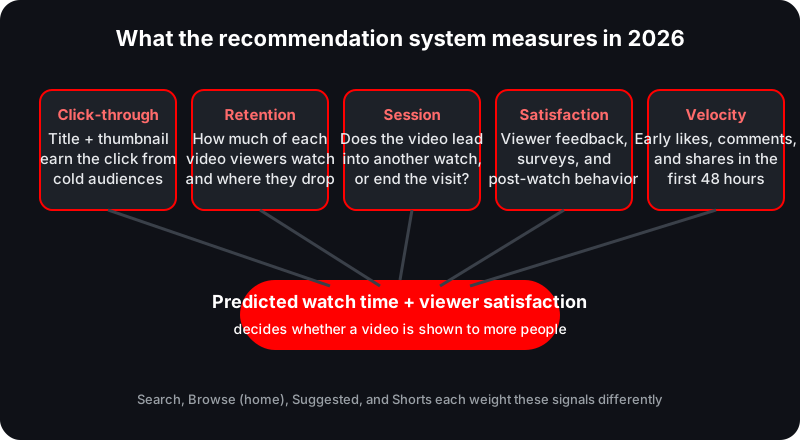
The signals that feed YouTube's recommendation systems. Each surface weights them differently.
The Signals Behind the Scores
Across surfaces, the same family of signals keeps appearing. Click-through rate (CTR) is the interest filter: if a thumbnail and title do not earn clicks from the audiences the video is tested against, the video never moves into wider distribution. Retention and average view duration are the quality validator: a video that viewers abandon quickly stops being recommended even when the packaging was effective. Session contribution measures whether a video extends the viewer's overall time on YouTube. Satisfaction signals, including in-app viewer surveys and post-watch behavior, tell YouTube whether the video delivered what was promised. Engagement velocity, the volume of likes, comments, and shares in the first 48 hours, signals whether a new upload deserves a broader test audience.
Signal
What it measures
What you can do
Click-through rate
How often the video is clicked when shown
Sharpen titles and thumbnails
Retention
How much of the video viewers watch
Tighten the hook and pacing
Session contribution
Whether the video leads to more viewing
Use playlists, series, end screens
Satisfaction
Whether viewers were pleased with the watch
Deliver on the title's promise
Engagement velocity
Early likes, comments, shares
Prompt discussion honestly
Not every signal matters equally for every channel. A video that earns impressions but few clicks has a packaging problem. A video with good click-through but a sharp early drop-off has a hook problem. A video that is watched fully but never leads anywhere has a session problem. Diagnosing which single weakness applies to your latest upload is more valuable than chasing every factor at once.
No tool, this one included, can predict rankings. YouTube's ranking system is private and it changes. The goal is to improve your odds on every upload, not to win a single guaranteed slot.
What Changed by 2026
YouTube's shift to watch time as the primary ranking signal happened in August 2012, when the platform announced that time spent would replace view count in recommendations. By 2026 the picture has evolved further: YouTube now weighs viewer satisfaction alongside raw watch time, and it increasingly optimizes for predicted watch time per impression rather than absolute minutes alone. The practical consequence is that a video with 3,000 views and strong retention can outperform a video with 10,000 views that viewers abandon quickly.
Session contribution has grown in importance more than any other signal. A video that ends and sends the viewer away from YouTube scores worse than one that leads into another watch. This is why playlists, series, and end screens matter more than they used to, and why a coherent channel with a clear "what to watch next" has a structural advantage.
YouTube also tests performance separately for returning viewers and new audiences. CTR from cold, non-subscribed audiences is weighted more heavily than clicks from existing subscribers, because it tells the system whether the video can earn new reach rather than just pleasing the audience it already has. For smaller channels, that is encouraging: a strong video does not need a big subscriber base to be tested with new viewers.
How Shorts Rank Differently
Shorts use a separate system that leans on immediate engagement. The decision to keep watching or swipe away in the first seconds, watch-through rate, rewatches, and shares all matter more than absolute watch time. A viewer who rewinds a Short and watches it again sends a stronger signal than one who watches it once. Long-form metrics like average view duration are still relevant, but they operate inside a much shorter attention window.
Running a channel on both formats works, but each format needs its own playbook. A Short should earn its keep in seconds; a long-form video has minutes to build a case. The two systems also feed each other: a Short that drives subscribers and curiosity can send viewers toward long-form videos, which is one reason many creators use Shorts as a discovery layer above a long-form core.
The click-through loop
A strong thumbnail earns a click from a cold audience. The video then has to hold the viewer. If retention holds, YouTube tests the video with more people, producing more clicks, and the loop continues. If early watch time collapses, the video stops being recommended even though the thumbnail was effective. The loop is the same on every surface; only the timing changes.
What You Can Actually Control
Ranking is private, but the inputs are not. You control topic selection, packaging, retention, and how each video connects to the next. Pick ideas with existing demand rather than invented demand. Write titles and thumbnails that promise something specific and true. Hold viewers with a hook in the first thirty seconds, then steady pacing that rewards the promise. And design a binge path, a recognizable format and series structure, so one view becomes a session.
Choose ideas with measurable demand from search and autocomplete.
Keep titles under roughly 60 characters and front-load the topic.
Deliver the promise early; a fast payoff protects retention.
Group videos into playlists and use end screens to continue the session.
Review your own retention graph and cut slow openings.
Publish on a rhythm you can sustain, because consistency compounds.
Use Public Data to Find Your Weak Point
You cannot see a competitor's private analytics, but public data reveals a lot. Compare your upload frequency, average views, engagement rate, and the age of your best-performing videos against comparable channels. The Creator Dashboard shows upload patterns and growth velocity, the Channel Analyzer gives an engagement snapshot for any public channel, and the engagement rate guide explains how the core metric is calculated. If your average views lag behind similar channels, the fix is usually packaging or topic selection; if views are healthy but growth is flat, the bottleneck is often session contribution.
Find the weak link in your channel
Run your channel through the Creator Dashboard to see upload patterns, growth velocity, and engagement in one view.
YouTube runs several ranking systems for Search, Browse, Suggested, and Shorts. They combine predicted watch time, viewer satisfaction, retention, and session behavior to decide which videos to show each viewer.
Is watch time still the most important ranking signal?
Watch time still matters, but YouTube now weighs viewer satisfaction alongside it. Session contribution, how much a video extends a viewer's overall time on YouTube, has grown in importance.
Is the Shorts algorithm the same as the long-form algorithm?
No. Shorts rank in a separate system that leans heavily on immediate engagement, the viewed-or-swiped decision in the first seconds, watch-through rate, rewatches, and shares.
Can any tool guarantee a video will rank?
No. YouTube's ranking system is private and changes over time. Tools like Norlytics provide public-data context, but rankings depend on viewer behavior.
Sources and Methodology
This guide synthesizes YouTube's official search and discovery documentation, the YouTube Data API reference, and reporting from creator-tool research published throughout 2026. Ranking mechanics change frequently, so treat this as process advice rather than a fixed set of rules.
 Norlytics