Content CreatorsLast updated August 5, 2026 · 8 min read
Creator Economy Trends 2026: What the Data Says About Where Creators Are Headed
The creator economy is now a measurable global market measured in hundreds of billions of dollars. Here is what the 2026 data says about market size, earnings, AI adoption, and the trends separating growing channels from stalled ones.
The creator economy is no longer a side story in the broader media landscape. It is a measurable global market, more than 200 million people now identify as content creators, and the revenue flowing through it is large enough that treating the work as a hobby is a strategic mistake. This guide collects what the data says about market size, earnings, AI adoption, and the structural shifts shaping where creators are headed in 2026.
How Big Is the Creator Economy?
Most widely cited estimates put the global creator economy at roughly $250 billion in 2026, with year-over-year growth of around 22%. Because the definition of the market varies — some analysts include platform payouts, sponsorships, merchandising, and adjacent services, while others count only a narrower slice — published figures land between roughly $252 billion and $314 billion. The range reflects how many revenue streams now count as creator income.
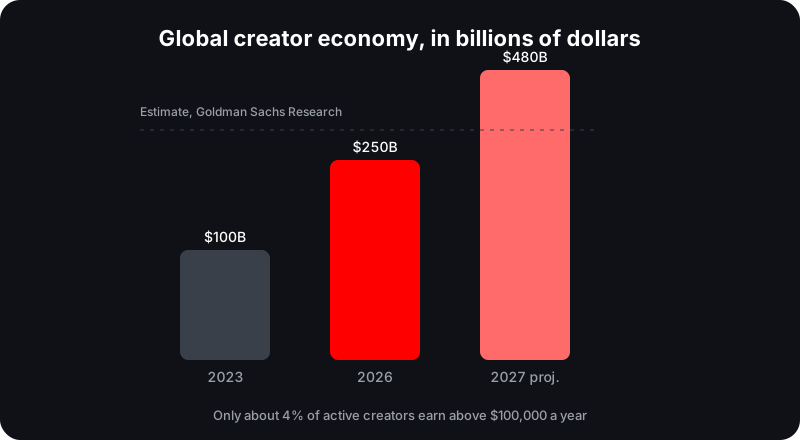
The cleanest long-term projection comes from Goldman Sachs Research, which estimated the creator economy's total addressable market at about $100 billion in 2023 and projected roughly $480 billion by 2027. Read from 2026, the trend line is steep and unbroken.
Global creator economy estimates: roughly $100B in 2023, about $250B in 2026, and roughly $480B projected for 2027.
Year
Estimated value
Context
2023
~$100 billion
Goldman Sachs Research baseline TAM
2026
~$250 billion
~22% year-over-year growth; range $252–314B
2027
~$480 billion
Goldman Sachs Research projection
None of these numbers is a precise census. Every published estimate depends on assumptions about which revenue streams count and how platform payouts are measured. The consistent signal across sources is direction: creation has moved from pastime to sector, and the growth has not yet leveled off.
Who Actually Earns From Creating
The supply side of the market is enormous, which makes the earnings picture sharper. More than 200 million people worldwide now identify as content creators, and one widely cited estimate puts active creators above that figure. Against that total, only about 4% of active creators earn more than $100,000 per year.
Those two numbers explain more about the creator economy than any growth figure. A very large number of people create content, and a very small fraction earns a full-time living from it. The gap between the median creator and the top earners is wide and, by most accounts, widening. That is why the strategies that follow lean on diversification and systems rather than chasing a single viral moment.
Earnings figures in this guide are directional, not guarantees. Your results will depend on niche, region, audience size, and advertiser demand, and they will shift over time.
Revenue Diversification Is the New Baseline
If one trend defines 2026, it is the move away from ad revenue as the whole story. Ads still matter — YouTube has paid creators more than $70 billion in the past three years, according to company statements referenced across industry reporting — but the channels that build durable income treat advertising as one line in a ledger that also includes memberships, fan funding, Shopping, and sponsorships.
Diversification also de-risks a channel. Platform policy changes, RPM swings, and seasonal advertiser demand hit a diversified channel far less than one that depends on a single payout source. When one revenue line dips, the others keep the channel stable.
Memberships and fan funding
Recurring fan support is the most predictable revenue a creator can build. Memberships and direct fan funding turn a committed audience into a monthly baseline. The thresholds and rules that govern these programs are covered in the 2026 monetization requirements guide.
Shopping, affiliates, and product income
Retail and affiliate revenue have moved to the center of the creator business model. For many channels, product sales and affiliate commissions now exceed what the same audience delivers in ad revenue. Our breakdown of affiliate and membership revenue explains how creators stack these lines.
Sponsorships as a strategic layer
Sponsorship remains one of the highest-value income sources per view, and brands are consolidating around creators with repeatable formats. A niche channel with fifty thousand loyal viewers can often negotiate sponsorships more effectively than a general channel with five times that many incidental views.
A diversified revenue mix
Consider a channel earning $1,000 per month from ads. With memberships covering part of the audience, affiliate links attached to a comparison video, and one sponsorship per quarter, the same viewership can produce two or three times that monthly total. No single line is enormous, but together they compound.
AI Is Now Standard Tooling
The most striking workflow statistic of 2026 is adoption. A large majority of creators — reported around 86% in 2026 surveys — now use generative AI somewhere in their workflow. That does not mean channels are fully automated. In practice, AI appears in research, drafting, thumbnails, captions, and repurposing, while the creator still owns the idea, the voice, and the final judgment.
The channels that treat AI as leverage rather than replacement are the ones producing consistent output without losing their identity. Our guide to AI tools for creators maps which parts of the pipeline benefit most and where human judgment still decides quality.
The Trends Shaping 2026
Beyond the headline numbers, a handful of structural shifts is redefining what a successful channel looks like. Together they describe where the market is headed.
Video-first podcasts
Podcasting has become a video format. The fastest-growing shows pair long-form conversation with faces, and audiences that discover them on YouTube often skip the audio-only version entirely. A video-first podcast is effectively a long-form channel with a built-in binge path and a dependable episode cadence.
Multi-platform distribution
Creators now treat a video as an asset rather than a destination. The same core idea gets cut, adapted, and reposted across platforms, with YouTube remaining the primary home where the deepest engagement and the most reliable revenue live. Multi-platform work widens reach, but sustainable models keep YouTube at the center, where session behavior and subscription revenue compound.
Community building as a retention strategy
With raw watch time losing its monopoly as the ranking focus, community behavior has become a retention lever. Channels that build predictable formats, recurring segments, and genuine audience interaction hold viewers across multiple uploads. Community is now a retention strategy, not a nice-to-have.
Satisfaction and session contribution
YouTube's ranking systems have shifted weight from raw watch time toward viewer satisfaction and session contribution. A video that leaves viewers satisfied and leads them into another watch outperforms one that racks up minutes but ends the session. The 2026 algorithm guide explains how those signals interact across surfaces.
What This Means for Your Channel
The data points in one direction. Creators who win in 2026 treat the channel as a business, diversify income beyond ads, use AI as leverage, and build an audience relationship that survives algorithm changes. The playbook is not complicated, but it is continuous.
Treat the audience as a product and a community, not as a number of views.
Diversify revenue across ads, memberships, fan funding, Shopping, and sponsorships.
Use AI for research, drafts, and repurposing while keeping editorial control.
Pick a repeatable format that turns one view into a session.
Track public data on comparable channels to set realistic benchmarks.
Rebuild the plan on a fixed cadence instead of chasing single-video spikes.
See how your channel measures up
Run your channel through the Creator Dashboard to compare growth velocity, upload patterns, and engagement against similar channels.
Estimates value the global creator economy at roughly $250 billion in 2026, with growth around 22% year over year. Depending on how the market is defined, figures range from about $252 billion to $314 billion. Goldman Sachs Research projected the total addressable market at about $480 billion by 2027, up from roughly $100 billion in 2023.
How many people work as content creators?
More than 200 million people worldwide now identify as content creators. Only about 4% of active creators earn above $100,000 per year, which is why the gap between the median creator and the top earners stays wide.
Do creators actually use AI in 2026?
Yes. Around 86% of creators in 2026 surveys report using generative AI somewhere in their workflow, mainly for research, drafting, thumbnails, captions, and repurposing, while keeping editorial control.
What is the biggest trend in the creator economy right now?
Revenue diversification beyond ads, including memberships, fan funding, Shopping, and sponsorships, combined with treating the channel as a business and community as a retention strategy. Session contribution and viewer satisfaction also matter more than raw watch time in ranking.
Sources and Methodology
This guide synthesizes YouTube's official documentation and public reporting. Figures that vary by audience, region, or advertiser demand are estimates, not guarantees.
 Norlytics